
There are few things in local government that sound as harmless as a penny.
One penny.
A single cent.
The kind of coin that lives in your cup holder, hides under your washing machine, and occasionally gets rejected by vending machines with more confidence than some elected officials.
And yet, in Georgia, that penny can become one of the most important funding tools a local government has. It can help pay for roads, drainage, public safety vehicles, parks, recreation facilities, government buildings, major equipment, infrastructure improvements, and other large capital projects.
That penny is called SPLOST, which stands for Special Purpose Local Option Sales Tax.
Yes, government managed to turn “one-cent sales tax” into a five-word acronym. We do that. It keeps the lights on.
In Augusta, SPLOST 9 is the next proposed round of that penny-based magic trick. The final adopted SPLOST 9 project list totals $375 million. That includes $107.958 million for Public Safety, $72.775 million for Quality of Life, $65.754 million for Facilities and General Government, $106.381 million for Infrastructure, $16.175 million for Other Governments, and $5.957 million for Authorities.
That sounds like an enormous amount of money, because it is.
But here is the awkward little secret about capital projects: by the time everyone has agreed on what needs to be done, what might be affordable, what can be placed on a ballot, what can be designed, what can be bid, and what can actually be built, that big number has usually gone on a very aggressive diet.
And not one of those polite diets where you still get dessert.
First, What Is SPLOST?
SPLOST is an optional 1% county sales tax approved by voters for specific capital projects. In plain English, it is a voter-approved penny sales tax used for things that are supposed to last longer than a lunch break: buildings, roads, drainage projects, parks, public safety equipment, infrastructure, major vehicles, and similar long-term investments.
It is not meant to be the normal operating budget. It is not the money that keeps the lights on, pays staff, buys printer paper, answers the phone, cleans the building, or explains to someone why the printer paper is gone again.
That distinction matters.
SPLOST can help build the building. It usually does not pay the person who has to unlock it every morning, staff it all day, clean it in the evening, and then explain on Facebook why the automatic doors are making that noise again.
That last part is apparently called “operations,” and SPLOST does not rescue you there.
How the Project List Is Born
The public usually sees the final SPLOST list, which makes the process look cleaner and more scientific than it really is.
A project appears with a name and a dollar amount, and people naturally assume someone has already priced the whole thing with surgical precision.
Surely, they imagine, an engineer, architect, project manager, finance director, procurement officer, attorney, contractor, and probably one wise elder with a clipboard sat in a room and determined that this exact number will complete the project.
That is adorable.
The real process is messier.
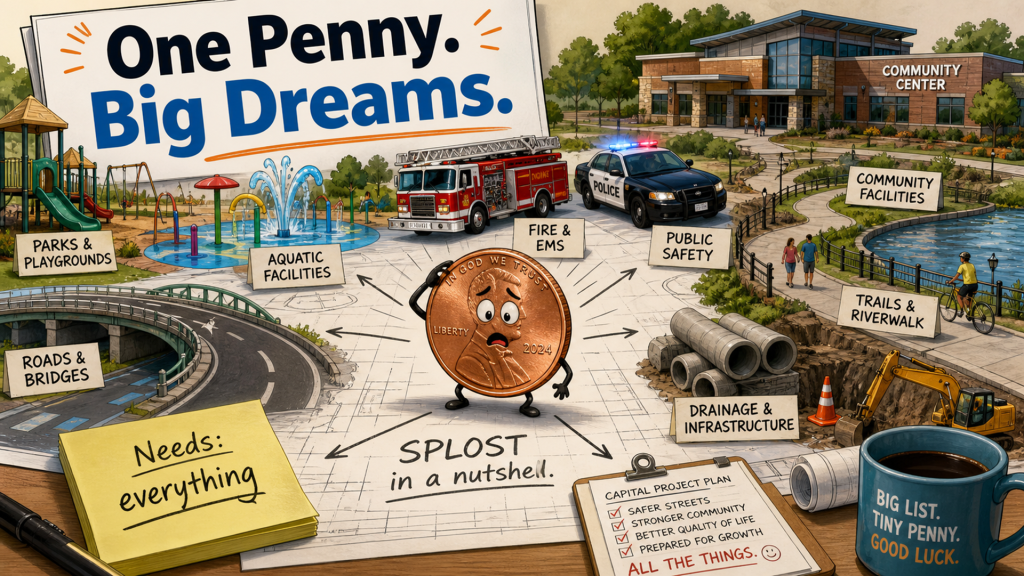
It usually starts with departments identifying capital needs. Public safety identifies vehicles, equipment, facilities, or detention center needs. Engineering identifies roads, sidewalks, drainage, bridges, and stormwater needs. Recreation and Parks identifies parks, facilities, aquatic systems, courts, trails, cemeteries, marinas, and other public-space needs. Central Services looks at buildings. Information Technology looks at systems and infrastructure. Utilities, airports, authorities, municipalities, agencies, and other stakeholders also bring their own needs to the table.
Then the list grows.
The public raises concerns. Commissioners advocate for district priorities. Administration weighs countywide needs. Departments refine requests. Agencies submit projects. Community needs, political priorities, infrastructure backlogs, safety concerns, grant opportunities, and long-deferred maintenance all join the party.
At this stage, the list is less of a neat plan and more of a buffet where everyone brought a casserole and nobody labeled the dishes.
This is how a local government can begin with hundreds of millions, sometimes more than a billion dollars, in identified or requested projects.
Then comes the painful part.
The Commission has to decide what actually fits inside the projected SPLOST revenue. That means choosing priorities. Some projects may be fully funded. Some may be partially funded. Some may be pushed to a later SPLOST. Some may be reduced, combined, renamed, phased, or gently escorted out of the room.
This is where the sentence “we need $20 million” becomes “you are getting $10 million, please clap.”
The List Grows, Then It Shrinks, Then It Shrinks Again
That is one of the most important things to understand about SPLOST.
The needs list grows because everyone identifies real needs.
Then the funded list shrinks because projected revenue is limited.
Then the project budget shrinks again because the listed amount is not all construction.
Then it shrinks again because of inflation.
Then it may shrink again when the design reveals site problems, code requirements, utility conflicts, drainage issues, structural concerns, environmental considerations, or that one mystery pipe nobody knew existed but everyone is now emotionally invested in.
So, when a department says, “We need $20 million to repair and improve this infrastructure,” that may be a legitimate estimate of the need.
But the final SPLOST list may only allocate $10 million.
That does not mean the original need disappeared. It means the available funding could not carry the whole project. The list had to fit the revenue estimate, and math, as always, arrived uninvited.
Now take that $10 million and fast-forward five years.
By the time the project is scoped, designed, reviewed, approved, procured, bid, awarded, and ready for construction, that $10 million no longer buys what it bought when the list was created. Construction inflation has been quietly chewing on it the entire time, like a raccoon in the attic.
The result is frustrating but predictable: a project may have been underfunded on day one, and then the underfunded amount loses even more buying power before construction begins.
This is not necessarily scandal. Sometimes it is just arithmetic wearing a hard hat.
The Project Name Is Not the Project Budget
Here is where SPLOST gets especially confusing.
A project list may say something like “Aquatic Facilities Improvements,” “Facility Revitalization,” “Riverwalk and Boathouse Reconstruction,” or “Roadway Resurfacing.”
Those names sound complete. They sound like the entire project has been fully defined, priced, designed, and gift-wrapped.
But a project name on a SPLOST list is often more like a funding container than a fully designed construction package.
A voter sees “park improvements” and imagines a finished park.
A department sees “park improvements” and knows that first there may be public input, site evaluation, design, cost estimating, drainage review, accessibility review, utilities coordination, procurement, permitting, bid documents, contract award, construction management, inspections, and probably at least three meetings where someone says, “Can we circle back?”
Nobody campaigns on “Vote Yes for Geotechnical Analysis and Procurement Lead Time.”
But without those steps, you do not get the project.
You get a shovel, a ribbon, a rendering, and a future problem with a very confident subject line.
The Money Starts Shrinking Before Construction Starts
Let’s say a project is listed at $10 million.
Most people understandably hear that and think: “Great. That means $10 million of construction.”
Not quite.
A capital project budget is not one big bucket labeled “bricks, concrete, playground equipment, asphalt, and hope.” It usually has several buckets.
Some of the money may go toward architecture and engineering. Some may go toward surveys, studies, environmental review, legal work, land acquisition, permitting, program management, project management, inspections, contingency, and administrative costs directly tied to delivering the project.
Engineers do not work for exposure.
Architects do not accept payment in inspirational renderings.
Attorneys, famously, do not run on vibes.
So a $10 million project might begin to look more like this:
| Budget Item | Example Amount |
|---|---|
| Listed project allocation | $10,000,000 |
| Design, architecture, engineering, surveys, studies | -$800,000 |
| Project or program management | -$300,000 |
| Contingency | -$1,000,000 |
| Other eligible delivery costs | -$200,000 |
| Approximate amount left for construction | $7,700,000 |
That example is simplified, but it shows the basic problem.
The public sees $10 million.
The construction bid may need to fit inside something closer to $7.7 million.
And again, that is before inflation enters the room wearing steel-toed boots.
SPLOST 9 as an Example
SPLOST 9 is a good example of how public needs, funding limits, and reality all wrestle in the same room.
The final adopted SPLOST 9 list totals $375 million. Public Safety receives $107.958 million, or 28.79%. Quality of Life receives $72.775 million, or 19.41%. Infrastructure receives $106.381 million, or 28.37%. Facilities and General Government receives $65.754 million, or 17.53%.
For Recreation and Parks, the SPLOST 9 list includes $70.861 million across multiple project areas, including Riverwalk and Boathouse Reconstruction, New Facility and Facility Revitalization, Aquatic Facilities Improvements, Diamond Lakes Regional Park Enhancement, landscaping and irrigation improvements, 5th Street Marina, cemeteries, New Savannah Bluff, capital equipment, and Augusta Sports Courts.
That is a major investment.
It is also spread across many needs.
It does not mean every park, facility, aquatic system, court, marina, cemetery, and Riverwalk need becomes fully funded, fully designed, fully constructed, and ready for a ribbon cutting by next Tuesday.
SPLOST gives projects a path forward.
It does not eliminate the laws of math.
Very inconsiderate, I know.

Why Not Just Estimate It Correctly?
This is the fair question, and it deserves a fair answer.
Early estimates are often made before the full project is fully known. At the SPLOST-list stage, the goal is usually to identify eligible capital needs, prioritize them, estimate available revenue, and create a package voters can consider.
That is not the same as having completed design drawings, construction documents, final engineering, environmental review, utility coordination, and bid-ready specifications for every project on the list.
Doing all of that before voters approve the funding would be expensive and risky. Imagine spending significant money to fully design a project before knowing whether the tax will pass. The same people demanding perfect estimates would then ask why money was spent designing something that was not funded yet.
And they would not be entirely wrong.
So early SPLOST estimates are often planning-level estimates. Some are based on concept plans. Some are based on known deficiencies. Some are based on prior projects. Some are based on departmental experience. Some are based on consultant input. Some are based on rough order-of-magnitude numbers.
Some age like fine wine.
Others age like gas station sushi.
The All-or-Nothing Problem
Another detail that matters: voters are not usually picking individual projects one by one.
They are voting on the whole package.
That means the project list is a political, financial, and practical balancing act.
A package has to be broad enough to address real needs across the community. It has to be specific enough to tell voters where the money is going. It has to be realistic enough to fit the revenue estimate. It has to be attractive enough to pass. It has to include enough priorities to gain support, but not so many that every project becomes a thimble of funding poured onto a bonfire of need.
Local government is often accused of not making hard choices.
SPLOST is one of the places where the hard choices happen. They are just disguised as spreadsheets.
The Difference Between a Promise and a Project
One of the biggest misunderstandings around SPLOST is the difference between these two statements:
“This project is on the list.”
And:
“This project will be fully completed exactly as imagined, regardless of cost escalation, design findings, bids, site conditions, or time.”
Those are not the same sentence.
A SPLOST list is a commitment to use voter-approved tax proceeds for the listed purposes. But the final scope of a project may still depend on design, bids, inflation, matching funds, permitting, site conditions, and available project balance.
In other words, the system knows reality happens.
Government created a reporting category for “we had a plan, and then reality entered the chat.”
The Public Deserves the Plain Version
The problem is not that SPLOST is bad.
SPLOST can be a very useful way to fund major improvements without relying entirely on property taxes. Because it is a sales tax, it is paid not only by residents, but also by visitors, commuters, tourists, shoppers, and anyone else making taxable purchases in the county.
The problem is that SPLOST is often explained in project-list language instead of real-world delivery language.
A more honest explanation would sound something like this:
“We have identified a major community need. We are allocating a planning-level amount toward that need. That amount may not fully fund the entire need. It must also cover more than construction. It may need to pay for design, engineering, project management, contingency, permitting, land-related costs, and other eligible project expenses. The final scope will depend on bids, inflation, site conditions, and available funding. We are not buying a completed project off a shelf at Costco.”
That may not fit neatly on a campaign flyer.
“Vote Yes for a Planning-Level Capital Funding Allocation Subject to Final Scope, Inflation, Procurement, and Construction Market Conditions” is not exactly bumper-sticker material.
Still, it would prevent a lot of confusion.
The $20 Million Problem
Let’s return to the example.
A department says, “We need $20 million to repair and improve this infrastructure.”
That may be accurate. It may even be conservative.
But the SPLOST process has to fit many needs into one revenue projection. So the project receives $10 million.
That means the project was partially funded from the start.
Then several years pass.
The $10 million must cover design, engineering, management, contingency, and other project delivery costs.
Then inflation reduces the buying power.
Then bids come in higher than expected.
Then everyone asks, “Why did you not build the full $20 million project?”
The answer is: because the project never had $20 million. It had half of that. Then the half had expenses. Then the expenses had inflation. Then the remaining construction budget had to meet the real market.
At some point, the penny is not failing.
The penny is exhausted.
It has been carrying a $20 million expectation on a $10 million back.
So, Should People Support SPLOST?
That is up to the voters.
My point is not to tell anyone how to vote. My point is that people should understand what they are voting on.
SPLOST is not a magic wand. It is not a blank check. It is not a guarantee that every listed project will emerge exactly as imagined, fully funded, perfectly timed, and delivered with a commemorative plaque that everyone agrees on.
It is a funding mechanism.
A useful one, yes.
A powerful one, yes.
But still just a mechanism.
The real work begins after the vote, when broad project names must become scopes, scopes must become designs, designs must become bid documents, bid documents must become contracts, and contracts must somehow become real things in the real world, where concrete costs money, weather has opinions, and inflation apparently has a gym membership.
So the next time someone says, “They allocated millions of dollars. Why is the project not finished yet?” the answer is probably somewhere between:
“Because capital project delivery is complicated.”
And:
“Because the penny is doing its best, but it is still only a penny.”
Both are true.
One is just more fun to say.
Disclaimer
This article reflects my personal views and general understanding of SPLOST as a local resident and government observer. It is not an official statement from Augusta, Georgia, or any department, board, commission, or office.
 Frankly Speaking