
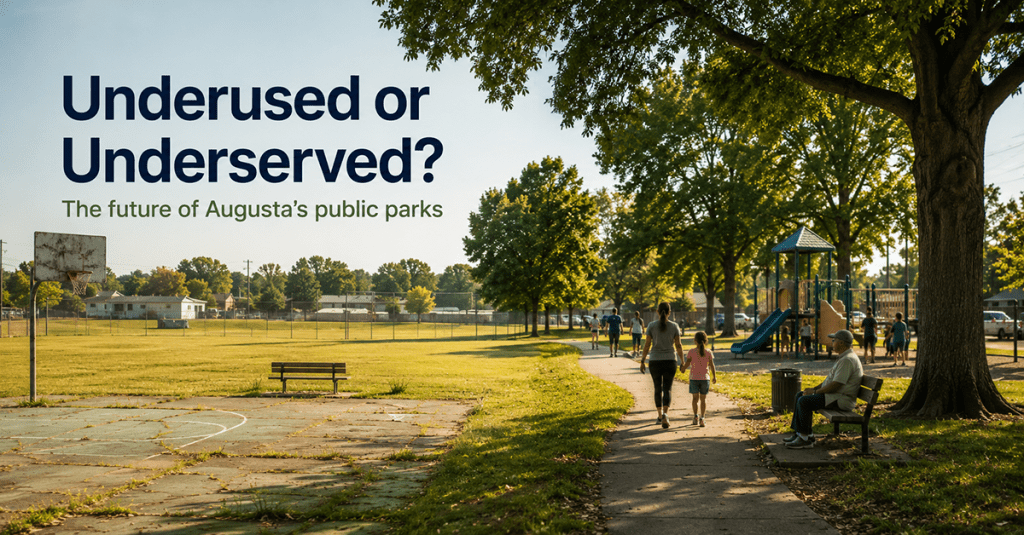
There are few phrases in local government that sound more reasonable than “underutilized asset.” It sounds clean, professional, and technical, like something that came out of a spreadsheet wearing a tie.
And in fairness, sometimes it is exactly the right phrase. A city can absolutely own too many facilities, too many small park parcels, too many aging assets, and too many places that require mowing, lighting, inspections, repairs, insurance, staffing, utilities, and the occasional emergency phone call because something has gone sideways at 7:42 p.m. on a Saturday.
That is real.
Augusta Recreation and Parks has a large inventory. Maintaining dozens of parks and facilities is expensive. It requires staff, equipment, operating funds, capital funds, planning, prioritization, and a level of coordination that does not magically appear because someone said “quality of life” into a microphone.
So yes, Augusta should be asking hard questions about its park system. But the most important question is not simply whether a park is underused. The better question is whether that park is underused because the community does not need it, or because the city has not given people enough reason to use it.
Those are two very different problems. If we confuse them, we may solve the wrong one with impressive confidence, which would be very government of us.
Augusta Has a Real Parks Problem
Let’s start with the part that should not be controversial: a public park system has to be manageable.
A park is not just grass and optimism. It has to be maintained. Playground equipment ages, courts crack, bathrooms break, trees need attention, lights fail, parking lots deteriorate, drainage becomes an issue, and trash cans do not empty themselves, despite what we all secretly wish.
A city can have a park inventory that looks impressive on paper but feels neglected in real life. That is not success. If Augusta has more public recreational spaces than it can properly maintain, then the result is not more service. It is diluted service.
That is the cruel trick of an overextended system. The map says you have a park, but the experience says you have a field with trust issues.
The goal should not be to keep everything forever. That is not planning; that is hoarding with a parks logo. The better goal is for Augusta to have a public recreation system that is safe, useful, equitable, financially realistic, and maintained well enough that residents can actually enjoy it.
That may mean some spaces need to change. Some may need to be redesigned, transferred, partnered, consolidated, or repurposed. And yes, some may eventually need to leave the inventory.
But the path to that decision matters. A lot.
The Problem With Calling a Park “Underutilized”
“Underutilized” sounds like a conclusion. In reality, it should be the beginning of an investigation.
A park can be underused for many reasons. Some of them are legitimate signs that the space may no longer serve a strong public purpose. Maybe the park is poorly located. Maybe it duplicates a better park nearby. Maybe it has limited access, limited visibility, and limited realistic potential. Maybe maintaining it costs more than the public value it provides.
That can happen. But a park can also be underused because it has nothing meaningful to offer.
No shade. No seating. No walking loop. No modern playground. No working lights. No restrooms. No programs. No safe pedestrian access. No reason for families, seniors, teenagers, or nearby residents to say, “Yes, that is where I want to spend my afternoon.”
At that point, low usage is not proof that the park is unnecessary. It may be proof that the park is unfinished, underfunded, outdated, or ignored.
Imagine opening a restaurant with no menu, no chairs, no air conditioning, and a sign that says “Good luck.” Then after two months, you announce that customer traffic is low and therefore the neighborhood clearly does not need food. Technically, you collected data. You just collected data on the wrong thing.
Parks work the same way. People use places that feel useful, safe, welcoming, and worth their time. If a park has been allowed to decline, usage numbers may tell us more about the condition of the park than the needs of the neighborhood.
That distinction should be at the center of Augusta’s conversation.
What Modern Park Planning Suggests
Modern parks research has moved beyond the old question of, “How many parks do we have?” That question still matters, but it is not enough.
A city can have many parks and still provide poor service. It can have green dots on a map that do not function well in daily life. It can have acreage that looks good in a report but does not help a child find a safe playground, a senior find a shaded walking path, or a family find a clean place to gather.
Today, the stronger planning question is this: Who has access to high-quality public space, and who does not?
That means looking at more than usage counts. It means looking at equity, condition, walkability, heat, shade, flooding, population density, youth needs, senior needs, disability access, health outcomes, transportation barriers, and the long-term cost of maintaining each site.
In other words, modern parks planning is not just about mowing grass. It is about managing public infrastructure.
And yes, parks are infrastructure. They are health infrastructure, climate infrastructure, social infrastructure, recreation infrastructure, and sometimes stormwater infrastructure. Depending on the playground, they may also be emotional-support infrastructure for parents who need their children to run around somewhere that is not the living room.
This is why a park’s value cannot be measured only by how many people walk through it during a short data window. Usage matters, but usage is not the whole story.
Where Augusta’s Current Approach Makes Sense
To be fair, Augusta is not wrong to examine its park inventory. Actually, it would be irresponsible not to.
If the city has too many facilities to maintain properly, then leaders have to make choices. Delaying those choices does not protect parks. It usually makes them worse. Deferred maintenance has a way of turning small problems into expensive problems while everyone is busy forming committees to discuss the original small problem.
A usage audit can be helpful. A divestment matrix can be helpful. Looking at maintenance costs can be helpful. Classifying parks by type, comparing proximity to other parks, and reviewing condition can all be helpful.
None of that is the issue.
The issue is how those pieces are weighted, interpreted, and translated into action. If low usage becomes the loudest voice in the room, Augusta risks treating a symptom as the diagnosis.
That is where the process needs caution, because a low-use park is not automatically a bad park. It may be a bad fit. It may be a bad design. It may be a bad location. It may be a good location with bad amenities. It may be a necessary neighborhood space that has never received the investment required to become what residents actually need.
Those differences matter.
The Risk of Using Low Usage as the Main Decision Point
Using low utilization as the main trigger for divestment creates several risks.
The first risk is punishing neighborhoods for past underinvestment. If a park has been neglected for years, residents may stop using it. Then the city measures low use and says, “See? Nobody uses it.” But the community might reasonably respond, “Of course nobody uses it. Have you seen it?”
That is not a usage problem. That is a trust problem.
The second risk is reducing access for people who depend on nearby public space. A park that looks redundant on a map may not be redundant to a child, an older adult, a person with a disability, or a family without reliable transportation. Half a mile is not just half a mile when there are no sidewalks, poor crossings, loose dogs, steep grades, heat, drainage problems, or traffic that treats pedestrians like unexpected wildlife.
Maps are useful. Walking the route is humbling.
The third risk is selling or giving away land the city may need later. Public land is easy to lose and hard to recover. Once it leaves the public inventory, future leaders may not be able to get it back when population patterns change, development increases, flooding worsens, or neighborhoods need new green space.
Land does not become cheaper because government suddenly regrets something.
The fourth risk is confusing low use with low value. Some parks provide value that is not captured by attendance counts alone. They offer shade, open space, neighborhood identity, stormwater absorption, tree canopy, informal play, or simply breathing room in areas that may not have much of it.
Not every public benefit scans neatly into a spreadsheet. This is disappointing to spreadsheets, but they will recover.
A Better Question: What Job Is This Park Supposed To Do?
Before Augusta decides whether a park should remain in the system, the city should ask a basic question: What is this park’s job?
Not every park should do the same thing. A regional park has a different job than a small neighborhood park. A trail corridor has a different job than a ballfield complex. A passive green space has a different job than a community center.
A small parcel in a dense neighborhood may not need to become a destination. It may simply need to be a safe, shaded, walkable place for nearby residents. That is still a job.
A good park system includes different kinds of spaces serving different needs. The question is not whether every park can become a major attraction. The question is whether each park serves a clear public purpose that justifies the cost of keeping it.
Some will. Some will not. But we should determine that through a thoughtful process, not just by asking which parks currently have the fewest visitors.
That is a little like judging a library by how many people check out books from the room where the lights are off.
What Augusta Should Measure Before Removing a Park
If Augusta wants a smaller, stronger, better-funded park system, it needs a broader decision framework. Usage should be one part of that framework, not the whole framework.
A better process would include these questions.
1. Is the Park in an Underserved Area?
Before considering divestment, Augusta should determine whether the park serves a neighborhood with limited access to quality public space.
That means looking at nearby alternatives, but not just as-the-crow-flies distance. The city should consider whether residents can safely walk, bike, use transit, or otherwise reach another park.
A park one mile away may be close for a driver. It may be completely unrealistic for a child walking alone, a senior with mobility challenges, or a parent pushing a stroller across a road designed like a racetrack.
2. What Is the Condition of the Park?
Condition matters, but it must be interpreted carefully.
If a park is in poor condition and underused, that does not automatically mean it should be removed. It may mean the park needs reinvestment, redesign, basic repairs, programming, a cleanup, lighting, or amenities that match what the neighborhood actually wants.
Poor condition should not automatically become evidence against the park. Sometimes it is evidence against the maintenance history.
Awkward, but true.
3. What Does the Neighborhood Need?
A park should not be evaluated in isolation from the people around it.
Does the area have many children? Older adults? Apartment residents without yards? Low tree canopy? High summer heat? Limited transportation access? Few safe walking routes? Health challenges that make active living more important?
A small neighborhood park in the right location may be more valuable than its current usage numbers suggest, especially if nobody has asked residents what would make them use it.
4. Can the Park Be Activated Before It Is Abandoned?
Before divesting a low-use park, Augusta should consider testing low-cost activation.
Try a cleanup day. Add temporary seating. Host a mobile recreation event. Bring in a walking club. Add shade. Improve signage. Repair the most obvious broken feature. Work with a neighborhood association, school, church, nonprofit, or civic group. Run a short pilot program.
Then measure again.
If usage increases, the issue was not lack of need. It was lack of invitation. Sometimes people do not use a space because the space has been quietly telling them not to.
5. What Are the Alternatives to Divestment?
Divestment should not be the only option on the menu.
A park could be redesigned as a lower-maintenance natural area. It could become a trail connector. It could be transferred to a partner under strict public-use conditions. It could be land-banked for future needs. It could be merged functionally with a nearby site while still preserving green space. It could be leased for community use. It could become part of a stormwater or urban forestry strategy.
There are more choices than “fully maintain it forever” and “get rid of it.” Local government loves binary choices because they fit nicely on agendas. Real life is usually messier, which is very rude of real life.
Responsible Divestment Is Possible
None of this means Augusta should never remove a park from its inventory. That would be too simple in the other direction.
Some sites may truly be poor candidates for continued public recreation use. Some may be too small, too isolated, too duplicative, too expensive, or too limited in future potential. Some may serve no clear recreation, environmental, connectivity, historic, or neighborhood purpose.
In those cases, divestment may be reasonable. But responsible divestment should meet a few standards.
It should be transparent. Residents should be able to see why a park is being considered, what data was used, what alternatives were reviewed, and how the final recommendation was made.
It should be equity-tested. The city should be able to show that removing a park will not worsen access for residents who already have fewer choices.
It should be community-informed. Not in the “we held one meeting at 2 p.m. on a Tuesday and three people came” sense. Actual engagement. Practical engagement. Engagement that reaches the people most likely to be affected.
It should also be financially honest. If divestment saves money, where will those savings go? Will they be reinvested into the remaining park system? Will they improve maintenance, safety, programming, accessibility, and amenities? Or will the money quietly disappear into the general fog of municipal finance?
The public deserves to know, because the goal should not be fewer parks for the sake of fewer parks. The goal should be better parks.
The Real Goal: Fewer Neglected Spaces, More Loved Places
A smaller park system can be better. That sentence may make some people uncomfortable, but it is true.
If a city has too many assets and not enough money to maintain them, the public experience suffers. A smaller, better-funded, better-planned system may serve residents more effectively than a larger system full of neglected spaces.
But smaller does not automatically mean smarter. A bad divestment process can shrink the map while deepening inequity. A good process can create a system where remaining parks are cleaner, safer, more accessible, more useful, and more financially sustainable.
That should be the target. Not just fewer acres. Not just fewer maintenance headaches. Not just a prettier spreadsheet. A better public experience.
The city should be able to say, “We made hard choices, and residents can see the improvement.” Cleaner parks. Safer playgrounds. Working restrooms. Better lighting. Shaded walking paths. More useful programs. More reliable maintenance. Better connections to neighborhoods.
Public spaces should feel cared for because they are cared for. That is the version worth aiming for.
A Practical Path Forward for Augusta
Here is what a better process could look like.
First, classify every park by purpose. Is it a neighborhood park, regional park, athletic facility, passive green space, trail connector, community center site, stormwater asset, historic space, or future redevelopment opportunity?
Second, create an equity and need score. Look at youth population, senior population, income, transportation access, health vulnerability, heat exposure, tree canopy, flood risk, and access to other quality parks.
Third, diagnose why a park is underused. Do not assume. Investigate whether the issue is condition, safety, lack of amenities, lack of programming, poor visibility, poor access, or truly low community need.
Fourth, test activation before closure when appropriate. Make modest improvements, add programming, partner with community groups, and measure whether use changes.
Fifth, compare alternatives. Reinvest, redesign, consolidate, partner, transfer, land-bank, convert to natural space, or divest.
Finally, tie any divestment savings to visible improvements in the remaining system. That last part matters. If residents see a park removed and nothing else gets better, they will not experience that as strategic planning. They will experience it as loss, and they will not be wrong.
The Question Augusta Should Ask
The most important question is not: Which parks are underused?
The better question is: Which parks are worth saving, changing, partnering, or letting go so Augusta can provide a recreation system people can actually use and trust?
That question is harder. It requires more data, more listening, more judgment, and more patience. Naturally, it is less convenient. But it is also more honest.
A park system is not successful because it has the most sites. It is successful when those sites serve people well. Augusta does not need a park inventory that looks good only in a report. It needs public spaces that work in real life.
Some parks may need investment. Some may need a new purpose. Some may need a partner. Some may need to be retired from the system. But no park should be treated as expendable simply because people are not using a place that may never have been given a fair chance to serve them.
Low use should raise a question. It should not automatically sign the paperwork.
Conclusion: Fix the System, Not Just the Map
Augusta is right to take its park maintenance challenge seriously. A city cannot maintain everything with wishes, meeting minutes, and a mower that has seen things. Public recreation requires real funding, real planning, and real choices.
But the answer should not be as simple as “underused equals unnecessary.”
Sometimes underused means unnecessary. Sometimes it means underserved. Sometimes it means underdesigned. Sometimes it means undermaintained. Sometimes it means the park has been waiting for someone to ask what it could become.
Augusta should build a manageable park system with enough funding to maintain it well. That may mean fewer sites. But it should also mean better service, stronger equity, clearer priorities, and public spaces that residents can be proud of.
The city should not just shrink the map. It should improve the system.
Because the real measure of success is not how many parks Augusta removes. It is whether the parks that remain are worth showing up for.
Frequently Asked Questions
Should Augusta close some parks?
Possibly. Some parks may no longer serve a strong public purpose or may be too costly to maintain compared to their benefit. But closure should come only after Augusta reviews equity, access, condition, community need, alternatives, and long-term cost.
Why is park usage data not enough?
Usage data shows how people are using a park now. It does not always explain why. A park may be underused because it lacks shade, amenities, maintenance, safety, programming, or walkable access.
What should Augusta do before divesting a park?
Augusta should identify the park’s purpose, evaluate neighborhood need, review access to nearby quality parks, assess condition, ask residents what they need, test low-cost activation, and compare alternatives before making a final decision.
How can Augusta reduce maintenance costs without abandoning neighborhoods?
The city can consolidate duplicative assets, redesign high-maintenance sites, partner with schools or nonprofits, convert some spaces to lower-maintenance natural areas, prioritize repairs, improve asset management, and reinvest savings into the remaining park system.
What is the best outcome for Augusta residents?
The best outcome is not simply fewer parks. It is a manageable, well-funded park system with cleaner, safer, more useful public spaces that serve residents fairly across the city.
 Frankly Speaking